


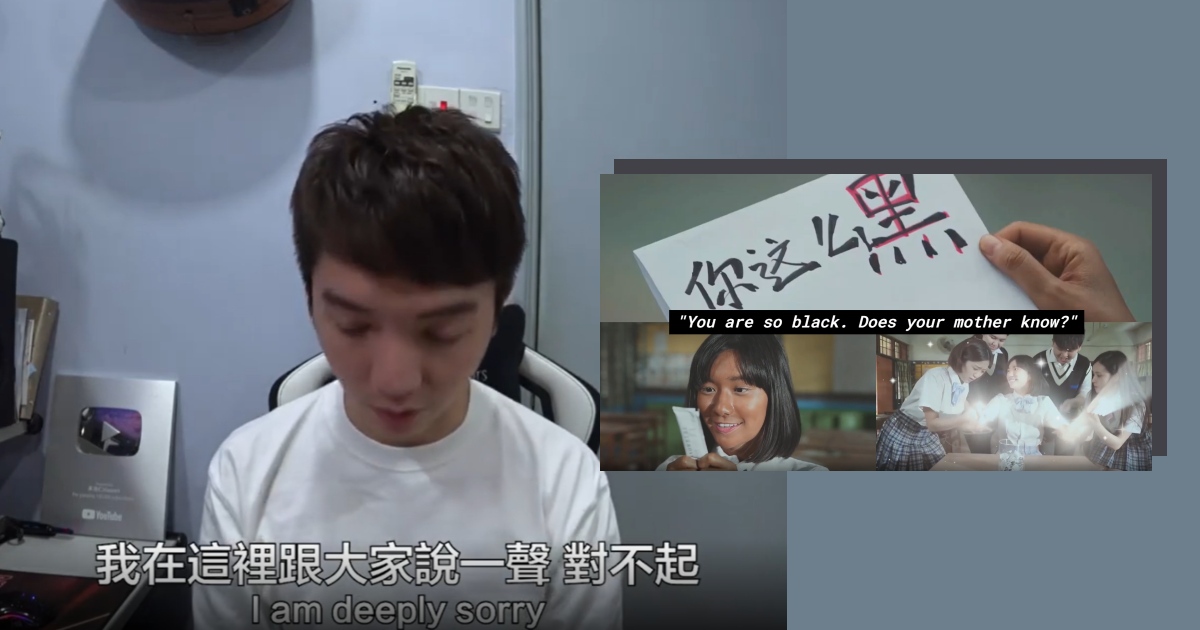
If you’ve been on social media in the past 24 hours, you would have seen the internet blow up with opposing views of a new advert posted to promote whitening products. The advert is shot like a music video and features a girl made to look “tanned” with makeup.

The video has since been taken down but many netizens who have seen the ad have been quick to slam the brand for the video and its implications.

The composer/lyricist/director/actor (yes, he played that many parts in the making of the music video) has since issued a statement on his Facebook page:
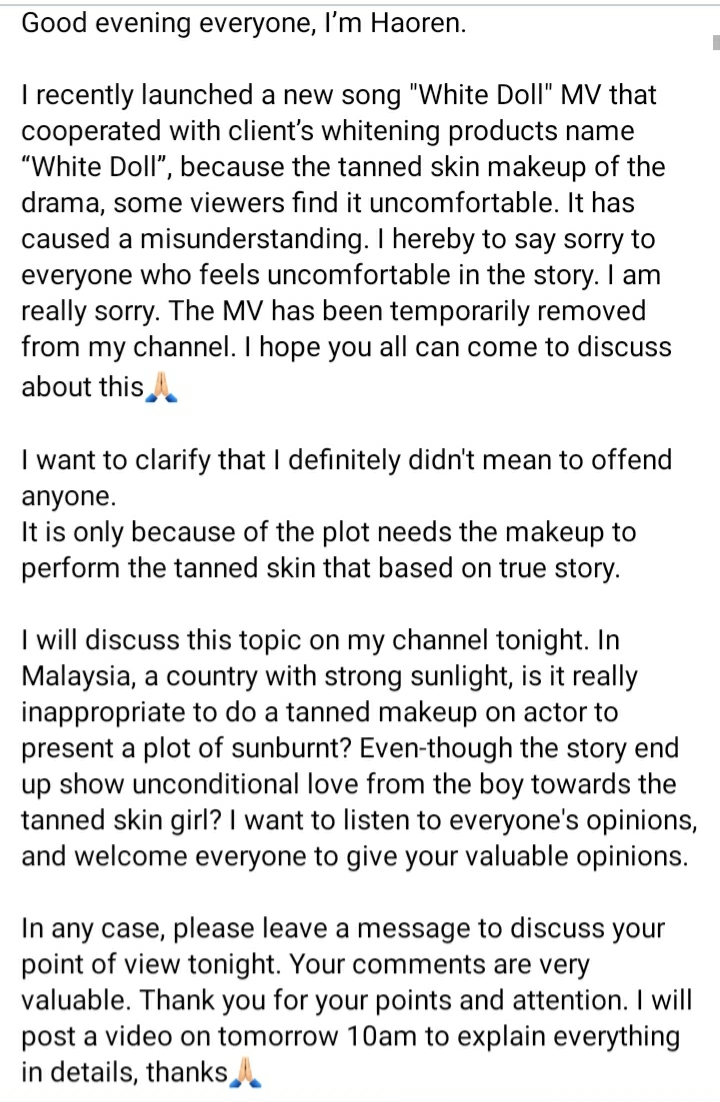
In his initial post, he claimed that there shouldn’t be anything wrong with the portrayal of the “tanned” girl “in Malaysia, a country with strong sunlight”. Since then, he has released a video to apologise for the controversy that the video has kicked up and explain his side of the story.
He goes on to justify his creative direction –
“The beginning of this MV shows a girl who often needs to walk to school under the hot sun, resulting in her sunburned skin. In school, she is often bullied and misunderstood. But the character that I play in the video starts to secretly place gifts in her drawer, giving her products every day as well as sunscreen, soy milk, umbrella, sun protective clothing and whitening products. In the end, she was able to recover from her sunburned skin and everyone was surprised and happy for her. But for me, still secretly hiding from her, my character took the courage to express my love for her only to bump into my love rival, ‘B’, who the girl assumed was the one leaving her the gifts. ‘B’ is someone who cares a lot about his appearance and was in a relationship with the girl so he could steal the whitening products that I would leave in the girl’s drawer for his own use. In the end, the girl eventually got her skin sunburned again. Eventually, the girl realised that B was not the one sending her gifts and decided to leave him. In the end, we finally meet and I ask her, ‘Have you been bullied by the sun lately? Did you consume the [whitening] products I’ve been leaving you?’.”
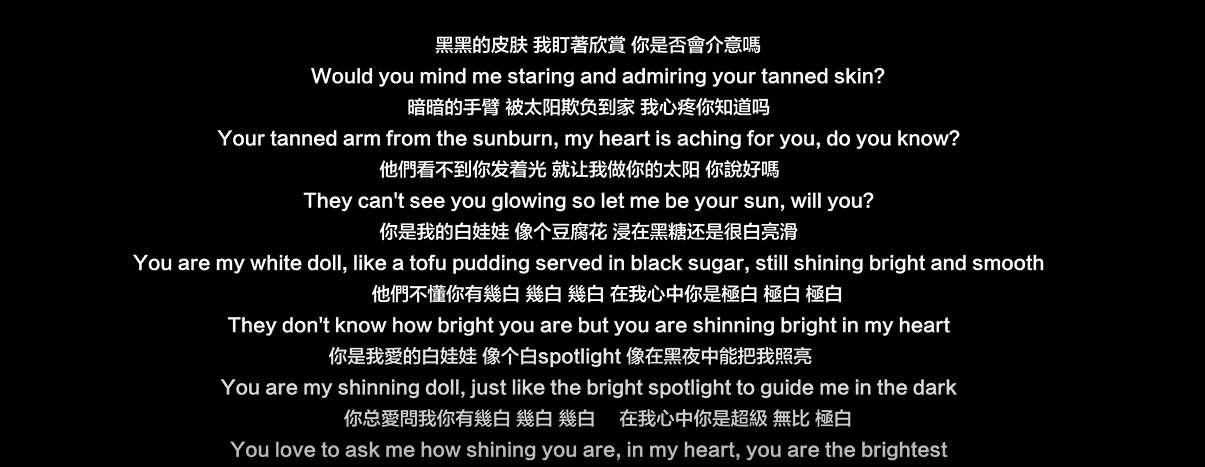
He even includes a translation of the lyrics in his video, stating:
“The meaning of the lyrics is to express that ‘my heart is aching for you, the person with sunburned skin, you are the brightest star in my heart’.”
But – to give credit where it’s due – he has expressed his desire to listen to the opinions of those around him and to discuss the issues with the video. He also apologises multiple times and admits that he is “still learning every day”. He also shares that he is “accepts all comments, feedback, and criticism with an open heart” as he “strives to become a better person”. This openness to learning and growth is not always present and thus should be acknowledged as a positive step forward.
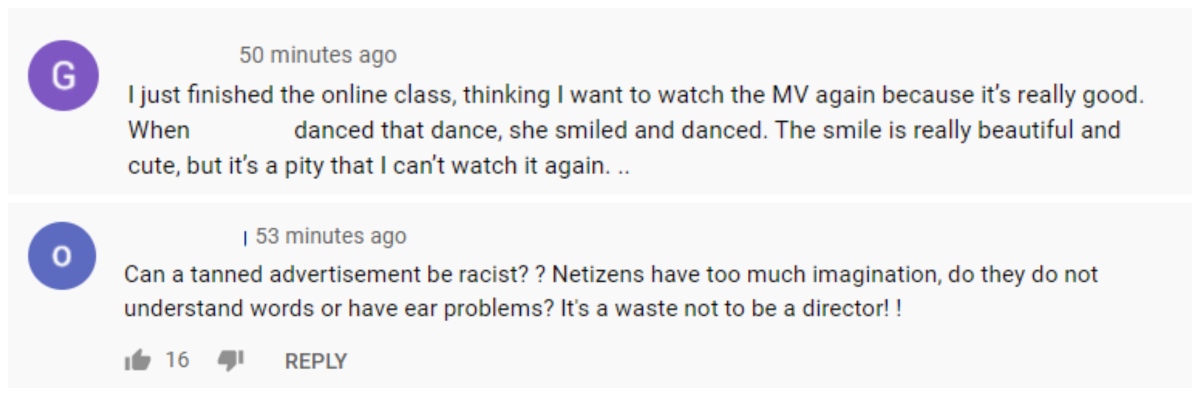
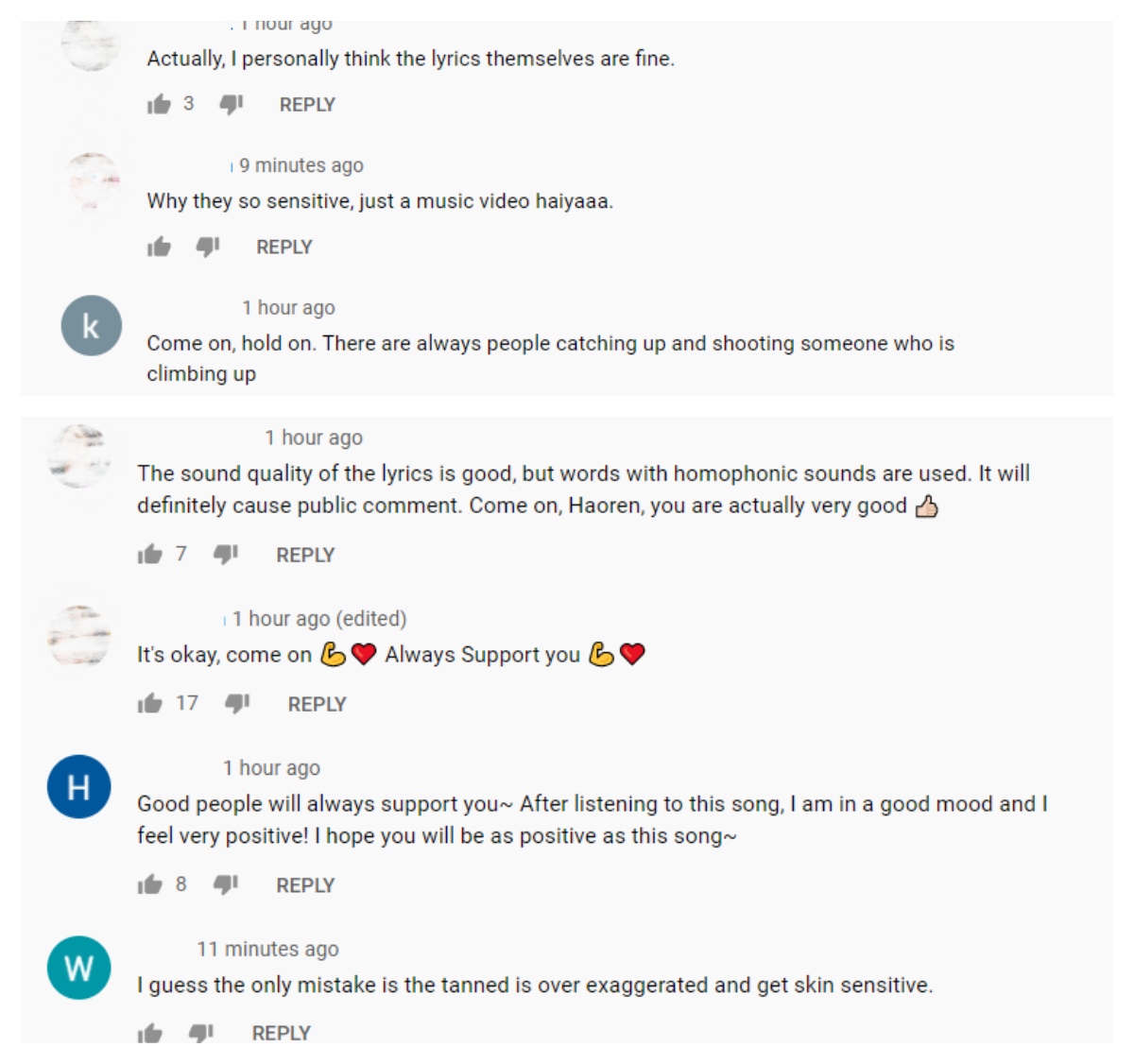
With that being said, there is still an obvious need to highlight and educate the masses on why it is a problem that someone of a different skin colour was “darkened” and then “whitened” and why the music video was seen as promoting the idea that being fair is more desirable. Unfortunately, with issues like colourism and racism, people who do not see the issue are often those who were never subject to such abuse nor discrimination – especially for something that one cannot change, like the colour of one’s skin. Comments on the video show that many do not see the problem with the music video or the way in which the girl was portrayed.
At the core of the issue, blackface made Black people seem different, laughable, less than their fairer counterparts for the mere reason that their skin colour was different. This idea that darker skin equals inferiority has fed the beauty industry for centuries, allowing them to make billions off “whitening” and “fairness” creams. ‘Lighter’ and ‘fairer’ skin has been almost fetishised in Asia, where most countries were taught that ‘white skin is supreme’ after having been colonised by the West for years. From this is born the problem of colourism:

This belief is especially prevalent in India, where the caste system and idea that ‘dark is dirty’ is deeply rooted in its society and in countries like China, where people with ‘fairer’ skin are viewed as ‘beautiful’, ‘elegant’ and ‘rich’. However, globally, almost 60% of women in India and 40% across Africa use products marketed for lightening skin, including bleach (as reported by AJ+). Nearly 6,300 tonnes of skin lighteners were sold worldwide last year, according to Euromonitor International, including products marketed as anti-ageing creams targeting dark spots or freckles while in China alone, marketing research shows that whitening products reached a whopping RM267 billion in sales.
Of course, this does not even begin to scratch the surface of the effect colourism has on young men and women who are growing up with this pressure to be “fair” and “lovely”. Colourism embraces lighter-skinned people over their darker-skinned counterparts, often leading the former to be viewed as more intelligent, noble, and attractive than darker complexioned people. In multiple parts of Asia, fair skin is linked to “wealth” and dark skin is seen as a sign of “poverty”, as people who do hard labour are more often in the sun. A-list actresses like Lupita Nyong’o, Gabrielle Union, and Keke Palmer – all gorgeous, beautiful women – have spoken about how they desired lighter skin growing up because they thought darker skin made them unattractive. Now imagine the impact of such thinking on the general masses of young men and women: if someone as highly lauded as Lupita Nyong’o can be made to feel inferior and ugly because of her skin colour, what about the rest of society? If it is continuously allowed for dark skin to be portrayed as being invaluable, unwanted and unloved by society then it merely feeds the unwarranted shame, displeasure and insecurity that darker skinned end up developing. Children, innocent and free of bias, will soon be tained with the idea that skin colour is the measure of how “good” or “bad” one is.
View this post on Instagram
The idea that being dark equates to being less deserving of love, respect or friendship is one that needs to be struck down. Your value does not and never will lie in how “fair” or “skinny” you are. At the end of the day, your worry should be about being respected, not liked and this will be apparent in how you treat others with equal measures of kindness, respect and love.

Post comments (0)